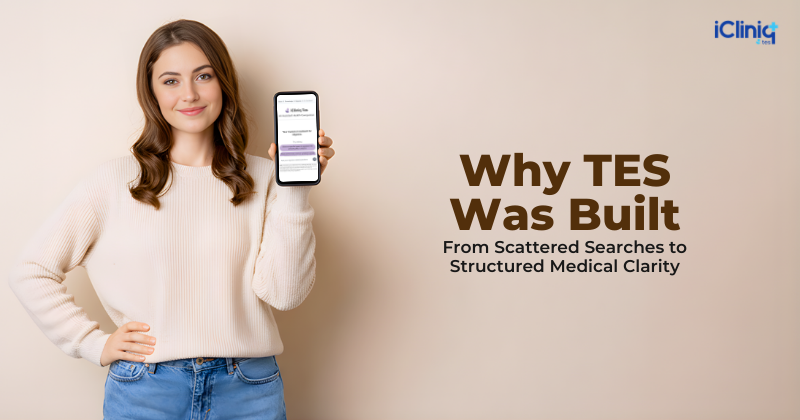
Why TES Was Built: From Scattered Searches to Structured Medical Clarity
Most health questions don't begin in a clinic. They begin in small, uncertain moments.
A new symptom appears at an inconvenient hour. A test result contains a number that is difficult to place. A medication causes an unexpected effect, and the instructions offer no useful context. The instinct, in nearly every case, is the same: search for answers immediately.
Not to self-diagnose. Simply to understand.
What people find instead is rarely understanding. Pages of information appear accurate, often detailed, but with little guidance on how to interpret any of it. Rare conditions sit beside common ones. Technical language sits between reassuring and alarming possibilities. The result is not clarity. It is a more structured version of the uncertainty they started with.
In our previous article, we explored why this gap exists and why it is harder to close than it might seem. This article is about what was built in response to it.
A Pattern Clinicians Kept Seeing
TES did not begin as a general AI tool searching for a medical application. It began with a clinical observation.
Over time, healthcare professionals began noticing a consistent pattern in consultations. Patients were arriving either highly anxious or genuinely confused, sometimes both. Not because they lacked access to information, but because the information they had found was unstructured.
A person might read ten different pages about a symptom and still leave not knowing:
- Whether the symptom is usually serious or usually minor
- What signs would actually change that picture
- Whether waiting, monitoring, or seeking care was appropriate
- What to say to a doctor when they got there
In many cases, the problem was not misinformation. It was information without clinical framing.
Healthcare professionals are trained to interpret symptoms through context, probability, and progression. They do not evaluate a concern in isolation; they consider how long it has been present, what accompanied it, and what pattern it fits. Most online resources are not built that way. They explain conditions thoroughly. They rarely explain how to think about them.
TES was conceptualized as a direct response to this gap: the space between a health question arising and a structured, grounded understanding forming.
From Clinical Conversations to a Structured System
Drawing from large volumes of real clinical questions and physician-reviewed material, TES was designed to reflect how health concerns are typically explained in practice, calmly, proportionately, and with context.
In clinical settings, reassurance is rarely about saying everything is fine. It is about explaining why something is likely to be common, what should be monitored, and when further care is genuinely needed.
TES was built to mirror that style of explanation at a general level. The focus from the beginning was on structure:
- Starting with what is common — not what is rare or alarming
- Outlining what actually matters — signs and patterns worth attention
- Indicating when care is needed — clearly, without dramatising
- Avoiding unnecessary alarm — proportionate responses to proportionate concerns
- Keeping language accessible — information that can be used, not just read
This structure is what most people struggle to find when searching for health information on their own. It is also precisely what a brief clinical conversation provides and what most digital tools have not yet managed to replicate.
Designed for Moments of Uncertainty
One of the guiding principles behind TES was a simple recognition: health questions often arise in moments of uncertainty, not in moments of preparedness. A person may not be ready for a full consultation. They may not even be sure whether one is necessary. They simply want to understand what they are experiencing well enough to decide what to do next.
TES was built to support that moment specifically.
It provides explanations that aim to organize information rather than scatter it, clarify next steps rather than overwhelm, distinguish between common patterns and genuine warning signs, and support more informed conversations when a clinician is eventually consulted.
The intention is not to provide definitive answers. It is to provide orientation.
When people feel oriented, they make calmer and more appropriate decisions about seeking care. They arrive at appointments with clearer questions. They describe their concerns more accurately. They are less likely to dismiss something significant or to overreact to something minor.
Working Alongside Clinical Care, Not Instead of It
From the beginning, TES was designed to complement professional care, not to compete with it.
Healthcare works best when people arrive at consultations with some understanding of their concerns and the ability to describe them clearly. When that understanding is absent, conversations on both sides can feel rushed, incomplete, or frustrating.
By helping people interpret symptoms and health information early, TES aims to make later clinical interactions more productive. Questions become more precise. Concerns are easier to articulate. The consultation itself becomes more collaborative.
The aim is not to reduce the role of clinicians. It is to improve the quality of understanding that comes before and between visits.
A Shift Toward Clearer First-Step Guidance
Access to health information is no longer the primary challenge. Interpreting that information responsibly is key.
TES represents an attempt to address that interpretation gap, to provide explanations that are structured, proportionate, and grounded in how health concerns are actually approached in clinical practice. Not the extremes. Not the lists. The pattern-based, probability-aware reasoning that clinicians apply every day.
It is built for the moments when people want to understand what is happening before deciding what to do. Moments that are common, often stressful, and consistently underserved by the tools that currently exist.
AskTES.ai is available now for those moments.
In the next article, we look more closely at how TES approaches health questions in practice, what makes medically guided explanations different from standard online searches, and why the boundaries TES operates within are as important as the answers it provides.